
Chained Dragon: China's Structural Limitations in AI
Tiers of restraint

By gating its chips, fencing off its lithography and rationing its model weights, Washington has converted a commanding lead in artificial intelligence and quantum computing into a deliberate instrument of statecraft against Beijing.
The strategy, refined across two administrations, aims less to outrun China than to lock the doors behind itself. Deny the silicon. Deny the software. Deny the equipment. Let economic distance compound.
For now, the bet is paying off. American frontier compute remains roughly three generations of process technology, an order of magnitude in private capital, and one strategic vocabulary ahead of its rival. Whether the moat keeps its depth depends on the durability of the controls, the elasticity of smuggling routes, and Beijing’s capacity to substitute scale for sophistication.
The Structural Gap
The numbers favour America with uncomfortable consistency. In 2025 organisations based in the United States released 50 notable AI models. Chinese institutions ranked second but well behind. Industry, mostly American, produced over 90% of the field.
Private investment in American AI startups reached $109.1bn in 2024, against $9.3bn for Chinese peers, the tenfold gap that funded the data-centre buildout now underwriting the lead. America hosts 5,427 data centres, more than ten times any other country.
The performance gap on the main benchmarks has narrowed almost to a sliver. As of March 2026 the top American model led its nearest Chinese competitor by 2.7 percentage points, down from a double-digit chasm two years earlier.
Closeness reflects Chinese efficiency, not parity of resources. China still produces more AI publications and patents than any other country, but the high-impact citations and the frontier model releases continue to come from California, Washington state and London.
The quantum picture mirrors the asymmetry. Beijing has poured roughly $15bn of public money into quantum information science, against America’s $4bn from federal sources. Private capital reverses the imbalance: American quantum firms have drawn around $3.7bn from venture and corporate backers, Chinese counterparts about $255m.
IBM’s Condor processor exceeded 1,000 superconducting qubits in 2023. China’s flagship Tianyan-504, announced in late 2024, runs 504. Its Zuchongzhi-3, opened for cloud use in October 2025, runs 105. American firms also lead the harder race for fault-tolerance, demonstrated by Google’s below-threshold error correction on its Willow chip in late 2024.
The Diffusion Framework
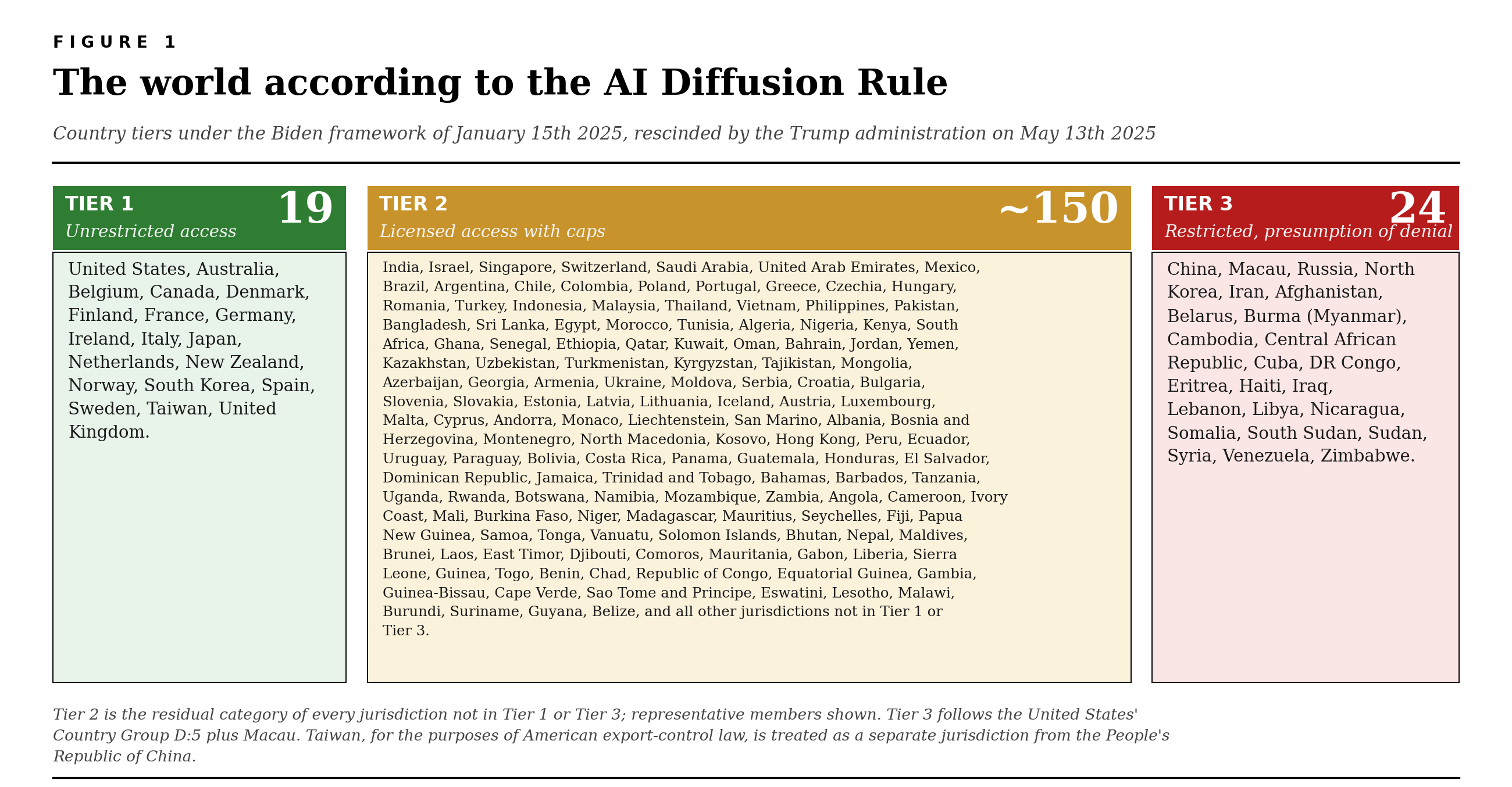
The Biden administration’s last major export-control act, the Framework for Artificial Intelligence Diffusion of January 15th 2025, codified that lead. The rule split the world into three tiers governing access to advanced AI accelerators and frontier model weights.
Tier 1 comprised the United States and eighteen treaty partners with unrestricted access. Tier 3 captured arms-embargoed jurisdictions plus Macau, all locked out entirely. Tier 2 was everywhere else, subject to licensing caps, per-country chip allocations and a 7% deployment ceiling for any single jurisdiction.
The framework was explicit about its purpose: to keep Tier 2 countries at least a generation behind the frontier, defined at 10 to the 26th floating-point operations of training compute, an order of magnitude beyond today’s leading models. The architecture acknowledged a hard truth. The geography of compute is the geography of power, and most of that compute already sits in a handful of allied territories.
From Biden to Trump
The diffusion rule’s life was short. The Trump administration rescinded it on May 13th 2025, two days before its compliance date. The Commerce Department called it overly complex, accused it of downgrading diplomatic partners and promised a simpler replacement.
The harder architecture has survived. Successive expansions of the…
Keep reading with a 7-day free trial
Subscribe to Pantheon Insights to keep reading this post and get 7 days of free access to the full post archives.